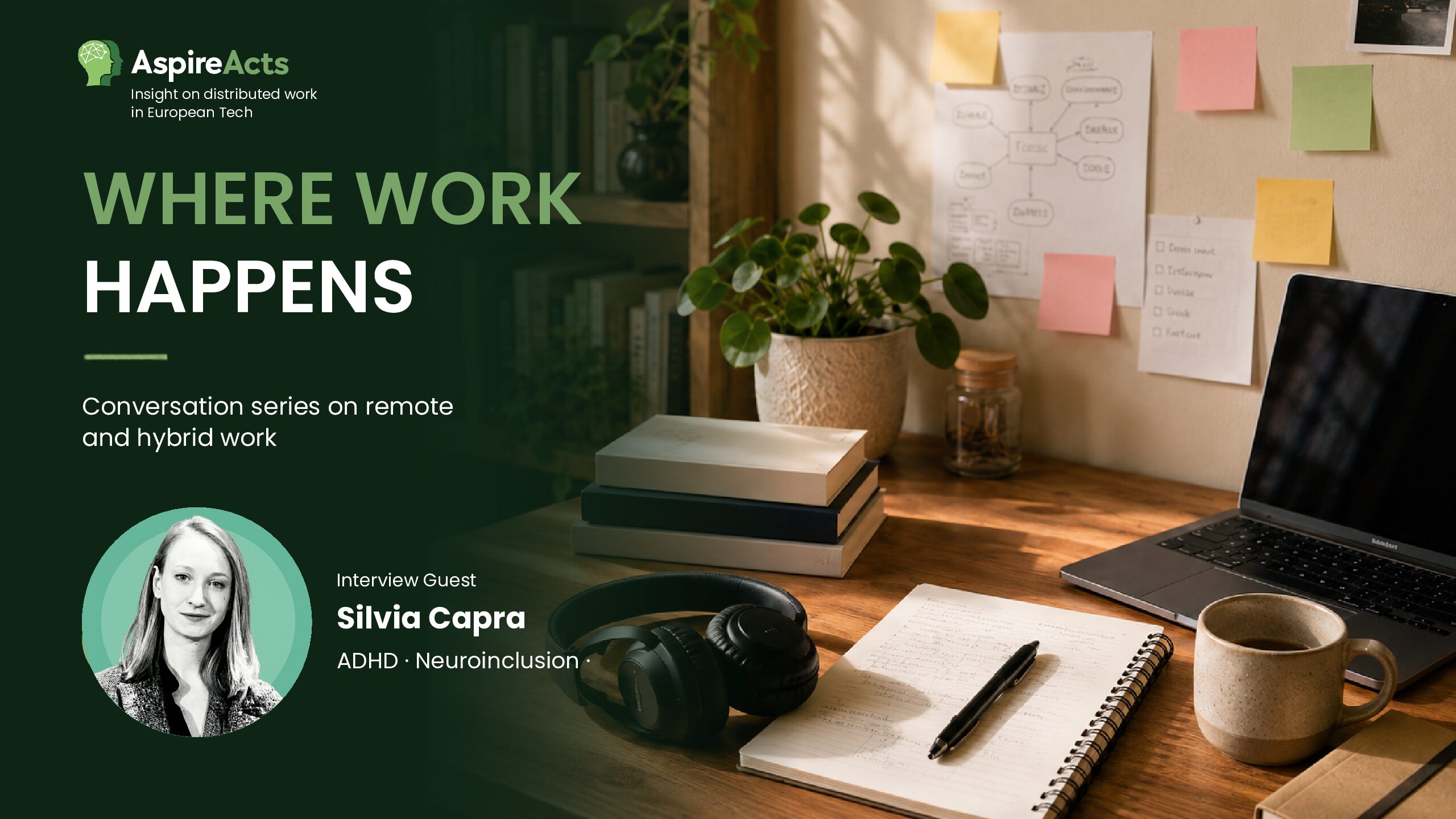
For decades, workplaces have been designed around shared environments, shared routines and shared expectations.We often assume that focus looks a certain way. That collaboration happens in familiar ways. That high performance is easy to recognise from the outside.But what if those assumptions only work for some people?In a recent Where Work Happens conversation, AspireActs spoke with Silvia Capra, founder of UnicaMente and neuroinclusion facilitator, about ADHD and distributed work.The conversation began with neurodiversity, but it quickly raised a broader question:What would work look like if it were designed for different ways of thinking from the start?
Focus does not always look the same
One of the strongest ideas from the conversation was that attention is often misunderstood.ADHD is not simply about a lack of attention. As Silvia explained, it is often more about regulating attention: directing it, sustaining it, and managing the many invisible skills that shape how work gets done.Planning. Prioritising. Remembering information. Managing emotions. Navigating expectations.These are not side issues. They are part of the everyday architecture of work.Silvia also challenged the way focus is often judged from the outside. Movement, doodling, headphones, clicking a pen, or looking away may be interpreted as distraction, when they may actually help someone stay engaged.This matters far beyond ADHD.Many workplaces still carry narrow ideas about what professionalism and focus should look like. Sitting still. Looking attentive. Responding in expected ways. Fitting into the room.But the real question is not whether someone looks focused.The question is whether the work environment helps them do good work.
Flexibility is not the absence of structure
Distributed work is sometimes discussed as if flexibility means less structure.This conversation pointed to something different.For many people, flexibility is not about having no boundaries. It is about having more control over the conditions that make focus, energy and contribution possible.That might mean managing noise levels. Using movement. Working with visual planning tools. Reducing interruptions. Choosing a calmer environment. Having information available before a meeting. Seeing the bigger picture before being asked to act.These may sound like small details.But for many people, they are not preferences. They are tools.And when work is distributed, organisations have an opportunity to think more intentionally about those tools: how work is communicated, how meetings are designed, how priorities are made visible, and how people are supported to contribute in different ways.
Better design often helps everyone
One of the most useful takeaways from the conversation was that ADHD-friendly work design is often simply better work design.Clearer communication helps everyone.Visible priorities help everyone.Better meeting preparation helps everyone.Less cognitive overload helps everyone.More intentional use of visual structure, diagrams, shared boards and concise information helps more people understand, remember and act.This is where neuroinclusion and distributed work connect.The goal is not to create a separate way of working for every individual. The goal is to design work with enough clarity, flexibility and intentionality that different people have a better chance of succeeding.
The wider lesson for distributed work
Although the conversation focused on ADHD, the lesson felt broader.People differ in how they process information, how they focus, and what they need from their environment to do good work.Creating space for those differences may be less about special accommodation and more about designing work well from the beginning.For organisations navigating remote and hybrid work, this raises an important question:
Are we designing work around how people actually function, or around old assumptions about how work is supposed to look?
Read the full Where Work Happens conversation on LinkedIn: link
Where Work Happens is an AspireActs conversation series exploring remote and hybrid work through the experiences and perspectives of people shaping how work is changing.